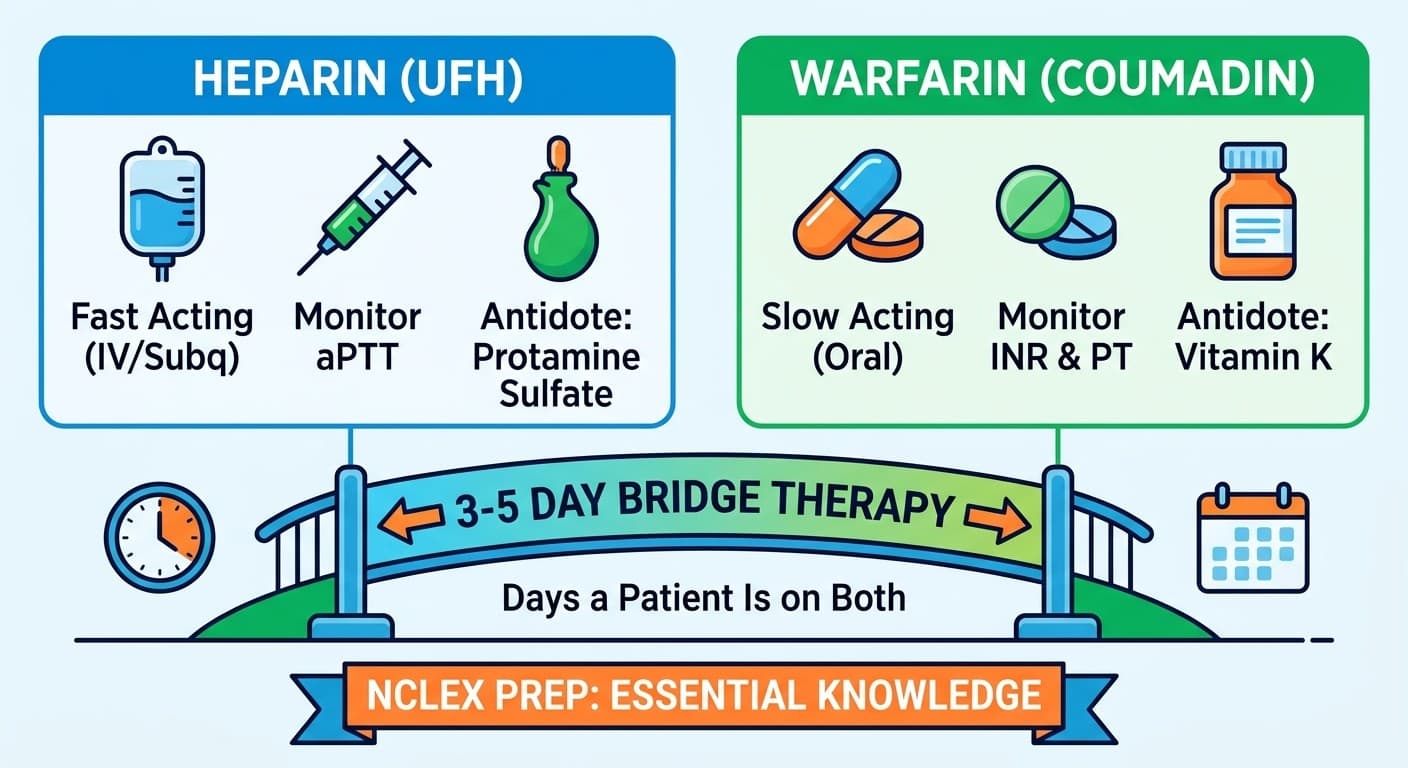
Heparin is tracked with the aPTT and reversed with protamine. Warfarin is tracked with the INR and reversed with vitamin K. Most lost marks come from the days a patient is on both.
Anticoagulant questions look like pharmacology and are mostly lab questions. Each drug has one test that tracks it, one antidote that reverses it, and one particular way it hurts people. Get those three right for each drug and most of the items in this topic answer themselves.
The pairing to lock in first: heparin goes with the aPTT and protamine sulfate. Warfarin goes with the INR and vitamin K. The distractors are written to swap them, and under time pressure students do.
Side by side
| Heparin (unfractionated) | Warfarin | |
|---|---|---|
| Route | IV infusion or subcutaneous | Oral |
| Onset | Immediate when given IV | Several days to full effect |
| How it works | Boosts antithrombin, which shuts down thrombin and factor Xa | Stops the liver making the vitamin K dependent clotting factors |
| Lab that tracks it | aPTT (some hospitals use anti-Xa) | PT/INR |
| Antidote | Protamine sulfate | Vitamin K (phytonadione) |
| Signature risk | Heparin-induced thrombocytopenia | Bleeding driven by drug and food interactions |
| Pregnancy | Does not cross the placenta | Contraindicated, causes birth defects |
| Typical role | Treating a clot now | Preventing the next one for months |
A mnemonic many students use is WEPT: Warfarin, Extrinsic pathway, PT. Whatever is left over, the aPTT, belongs to heparin.
Heparin
Heparin works the moment it enters the vein, which is why it is the drug for an acute clot such as a deep vein thrombosis or a pulmonary embolism.
The aPTT. On a continuous infusion the usual goal is 1.5 to 2.5 times the control value. The infusion rate is adjusted from a weight-based protocol against that number. When a stem gives you an aPTT well above the target, the answer is to hold or reduce the infusion as the protocol directs, assess for bleeding and notify the provider. Rechecking in a few hours while the drip runs on is the distractor.
Protamine sulfate reverses it within minutes. It is given slowly IV, because a fast push can drop the blood pressure.
Heparin-induced thrombocytopenia (HIT) is an immune reaction that usually shows up 5 to 10 days after heparin is started. The platelet count falls by half or more and, against intuition, the patient starts forming clots. That is why platelets are checked during heparin therapy. A platelet count that has halved by day 7 means all heparin stops, including heparin flushes, and the provider switches to a non-heparin anticoagulant such as argatroban. Switching to enoxaparin is wrong, because it cross-reacts.
Subcutaneous technique is tested on its own:
- Abdomen, at least 2 inches (5 cm) from the umbilicus.
- Do not aspirate, and do not rub the site afterward. Both cause bruising.
- Never intramuscular, because of the risk of a hematoma.
Low molecular weight heparin
Enoxaparin is given subcutaneously at a set dose and does not need routine aPTT checks, which is why patients can go home on it. In a prefilled syringe, leave the air bubble in, so no drug is lost. Protamine only partly reverses it.
Because neither form of heparin crosses the placenta, low molecular weight heparin is the usual anticoagulant in pregnancy.
Warfarin
Warfarin stops the liver making new clotting factors, but the factors already circulating have to wear out first. That takes days, so warfarin does nothing for a clot that needs treating today.
The INR. For most uses, including atrial fibrillation, DVT and pulmonary embolism, the target is 2 to 3. Mechanical heart valves run higher, commonly 2.5 to 3.5. Someone who is not on warfarin has an INR of about 1.
The INR is checked before the dose, not after. If it comes back above the patient's target range, hold the dose, assess for bleeding and notify the provider.
Vitamin K reverses it, but over hours, not minutes. For life-threatening bleeding, the provider adds clotting factors too, as prothrombin complex concentrate or fresh frozen plasma.
Diet: consistent, not avoided
This is the most tested piece of warfarin teaching. Leafy greens such as spinach, kale and broccoli are rich in vitamin K, and vitamin K works against warfarin. The patient does not need to give them up. They need to eat about the same amount each week, so the dose can be set around their normal diet.
An answer telling the patient to avoid all green vegetables is wrong. An answer about keeping intake steady is right.
The rest of the teaching
- Take it at the same time every day. Don't double a missed dose without advice.
- Avoid aspirin and NSAIDs unless the provider has prescribed them. Acetaminophen is the usual choice for minor pain.
- Tell every prescriber, dentist and pharmacist. Antibiotics, amiodarone and many other drugs move the INR.
- Herbal products count. Ginkgo, garlic, ginger and ginseng are the usual exam examples.
- Keep alcohol low.
- Use a soft toothbrush and an electric razor.
- Report black stools, blood in the urine, nosebleeds that won't stop and unexplained bruising.
- Wear medical identification.
The overlap: when the patient is on both
This is where most anticoagulation questions actually live.
A patient with a new DVT starts heparin or enoxaparin because it works now. Warfarin starts at the same time or soon after, because it takes days to work. Both continue together until the INR has been in range, typically for at least 24 hours after at least five days of overlap. Only then does the heparin stop.
So:
- Heparin drip running, warfarin started yesterday, INR 1.3: continue both. This is the plan working, not an error.
- A family member asks why the patient is getting two blood thinners: the right response explains that the tablet hasn't started working yet.
- Heparin stops when the INR is therapeutic, not when the aPTT looks good and not on the day of discharge.
The newer oral anticoagulants, briefly
Apixaban, rivaroxaban and dabigatran are now common. What the exam wants: they need no routine INR monitoring, they have far fewer food interactions, and neither vitamin K nor protamine reverses them. Dabigatran has its own reversal agent, idarucizumab. If a stem asks which lab to follow for a patient on apixaban, the INR is the distractor.
Working one of these items
- Name the drug, then its lab. Heparin, aPTT. Warfarin, INR. Enoxaparin and the newer oral drugs, usually no routine test.
- Compare the value with the target. Above it: hold, assess for bleeding, notify.
- If the stem mentions bleeding or an overdose, match the antidote. Protamine for heparin, vitamin K for warfarin.
- A platelet count falling after several days of heparin is HIT until proven otherwise. Stop all heparin.
- For teaching items, look for steady vitamin K intake and avoiding aspirin and NSAIDs.
The most expensive mistakes
- Following the INR for heparin, or the aPTT for warfarin.
- Giving vitamin K for a heparin overdose, or protamine for warfarin.
- Telling a patient on warfarin to stop eating green vegetables.
- Treating the heparin and warfarin overlap as a medication error.
- Aspirating, or rubbing the site, after a subcutaneous heparin injection.
- Missing a halved platelet count on day 7 of heparin.
- Warfarin for a pregnant patient.
These pairings come up inside prioritization questions as often as in pharmacology ones. Drill them in the free NCLEX-RN practice questions, and keep the lab values guide open while you do.